Three ways to roof a patio
Patio Covers
Nearly every patio comes down to one question: do you want a roof you can open, a roof that stays shut, or a roof that finishes like a ceiling. All three are pre-painted baked aluminium, made to your measurements and fitted by our own teams. Here is how they differ.
 Option 1
Adjustable
A roof you can open
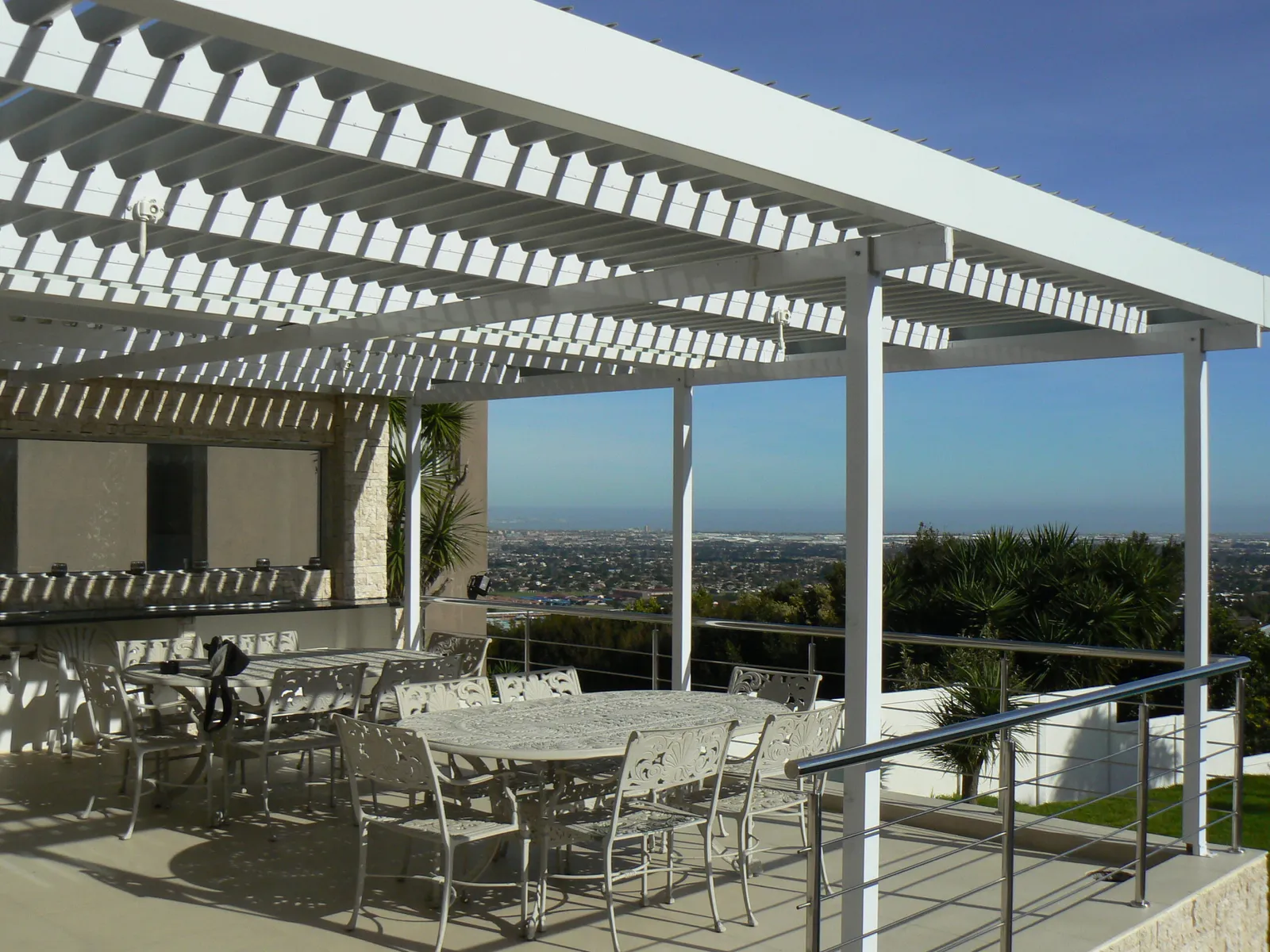
Aluminium blades set in a frame, turned by a gearbox. Open them flat and the patio is effectively uncovered, so the low winter sun still reaches the back of the house. Tilt them through the afternoon and you cut the glare without losing the light. Close them and the roof is sealed, with rain running off the blades into the gutter in the frame.
It is the most expensive of the three because it is a working mechanism as well as a structure, and it is the one people regret least. If the patio is the room you actually live in, this is the answer.
- Blades tilt from 0° to 82°, fully open to fully closed in one and a half turns
- Manual or motorised, and the gearbox can be motorised later
- Best for patios you use through every season
 Option 2
Solid
A roof that stays shut
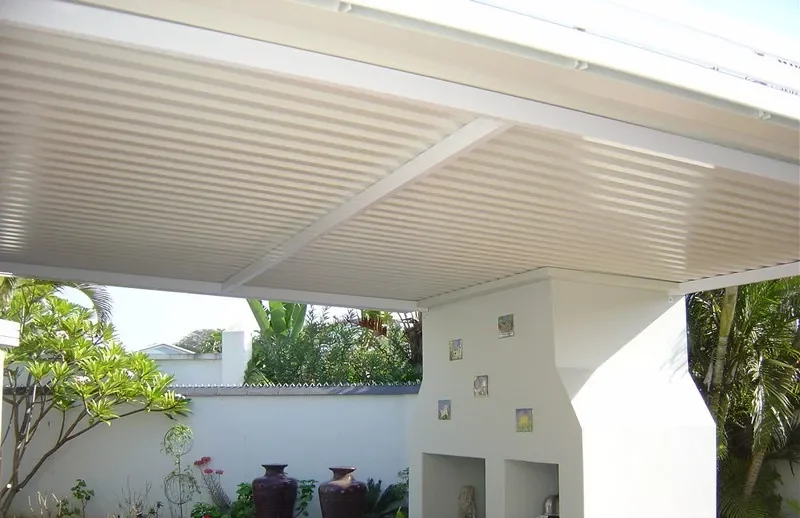
Baked aluminium IBR sheeting on an engineered frame. Nothing moves, nothing to service, and no mechanism to pay for. It goes up in a day or two and it will still look the same in fifteen years, because the colour is baked into the metal rather than sprayed on afterwards.
The trade-off is light. A solid roof shades the patio permanently, and if there are rooms behind it they will be darker than they were. Where that matters we mix in clear or tinted polycarbonate panels over the part of the span that needs daylight.
- No moving parts, so nothing to maintain or repair
- Handles hail and highveld storms without being closed first
- Best for big spans and patios where shade is the whole point
 Option 3
Solid, with a finished ceiling
A roof that reads as a room
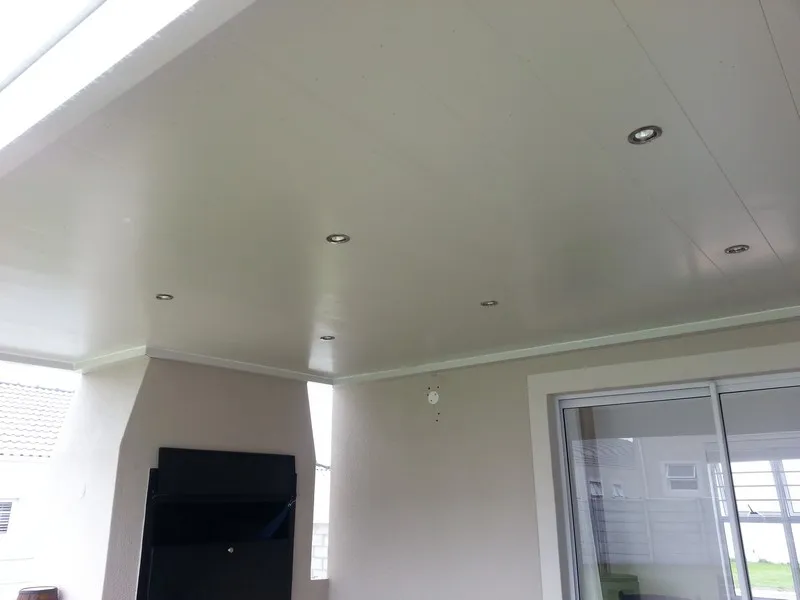
The same solid cover as option two, but finished underneath with an aluminium ceiling instead of leaving the sheeting and the structure on show. From below you see one clean plane. The box gutter is built into the frame and the downlighters are recessed into the ceiling during the install, so there is nothing hanging down.
This is what turns a covered patio into part of the house rather than something attached to it. It is also the version people choose when the patio faces the pool or the street and gets looked at as much as it gets used.
- Recessed downlighters wired in while we build, not added later
- Box gutter inside the frame, so no visible plumbing
- Best for patios that should feel like an outdoor room
Side by side
Which patio cover suits your patio?
Cost tiers compare our own three cover ranges against each other: R is the most affordable, RRR the most premium. Every cover is made to measure, so size, span and site access move the price. Your consultant confirms an exact written figure on site, free of charge.
| Option | Cost tier | Rain | Light | Best for |
|---|---|---|---|---|
| Adjustable louvres | RRR | Sealed when the blades are closed, open to the sky when they are not | Full control: 0° to 82° | Patios used all year, where you want the winter sun back |
| Solid fixed aluminium | RRR | Permanent cover, nothing to close first | Shaded permanently; add polycarbonate panels where daylight must fall | Large spans, hail country, patios where shade is the point |
| Solid with a ceiling | RRR | Permanent cover with a box gutter built into the frame | Shaded, with recessed downlighters for the evening | Patios that should feel like an outdoor room |
Every cover carries our 10-year guarantee on materials and a year on workmanship, in any of 23 baked-on colours. Request a free written quote and we will measure on site.
Not a roof, but worth knowing
Two things people add afterwards
Neither of these is a patio cover on its own, and both come up on almost every site visit once the roof is decided.
Drop blinds close the open sides. A roof stops rain from above but does nothing about a southeaster coming in sideways, or the late sun straight up the length of the patio. Drop blinds roll down when you need them and out of sight when you do not, and the clear PVC panels mean you keep the garden view with the wind outside. They can be fitted to a cover we built years ago, so there is no need to decide now.
Folding arm awnings are the alternative to a roof rather than an addition to one. A fabric canopy on hinged arms that extends for shade and folds flat against the wall when you want open sky. It suits a balcony or a small patio where a permanent structure would be too much, and it is the cheapest way to shade a set area. It is not a rain solution: it should be retracted in strong wind or heavy rain.
Read before you decide
Guides to the detail
The comparison above is the short version. These go further on the questions that decide it.
- The best patio cover for Highveld storms and the Cape Doctor, if wind is the deciding factor on your site.
- Patio ceilings vs louvre awnings, which is options two and three above, head to head.
- Why aluminium beats wood, steel and fabric, on upkeep and lifespan.
- Louvre awnings vs traditional pergolas, if you are weighing a timber pergola.
- What affects the cost of a louvre awning, on where the money actually goes.
- Do you need council approval? Sometimes, and it depends on your municipality and the span.
Good to know
Choosing a patio cover: common questions
Which one is best if it rains a lot where I am?
Either of the solid options. They are covered the moment it starts rather than needing anything closed first, which matters if the patio is used when nobody is home to think about it. Adjustable louvres seal against rain too, and they have the advantage of opening up again the moment it clears, but somebody has to turn them, or you specify the motorised version with a rain sensor.
Will a solid cover make the rooms behind the patio dark?
Some, yes, and it is the most common thing people wish they had thought about. Where rooms open onto the patio we mix clear or tinted polycarbonate panels into the span over the doors, so daylight still reaches inside while the seating stays shaded. On an adjustable louvre roof the question does not arise, because you open the blades.
Can I add drop blinds later, or must it be done now?
Later is fine. Drop blinds fit to the posts and beams of a cover that is already up, including covers we built years ago. Plenty of people live with the roof for a season, work out which side the wind actually comes from, and then add blinds to that side only.
What does a patio cover cost?
It depends on the span, the structure it fixes to and how easily we can get material onto the site, so a square-metre figure on its own is misleading. The comparison table above shows how our three ranges sit relative to each other. The site visit and the written quote are free and carry no obligation, and that is the only number worth planning around.
How long does it take?
Manufacturing happens after we measure, then installation is typically one to three days on site depending on the size and complexity. Our own teams do the measuring, the manufacturing and the fitting, so there is no subcontractor in the middle of it.
Free consultation & quote
Request a free quote today.
Tell us what you have in mind and where you are. One of our own consultants (not a call centre) comes back to you, measures on site and quotes with no obligation.
Four branches nationwide
We service all areas in Cape Town, Johannesburg, Pretoria and on the Garden Route
Local teams measure, manufacture and fit from four branches: head office in Cape Town, plus Johannesburg, Pretoria and Wilderness.